Reading the worklist
The worklist is a ranked list of opportunities. This page explains how to read one row and how the list is ordered.
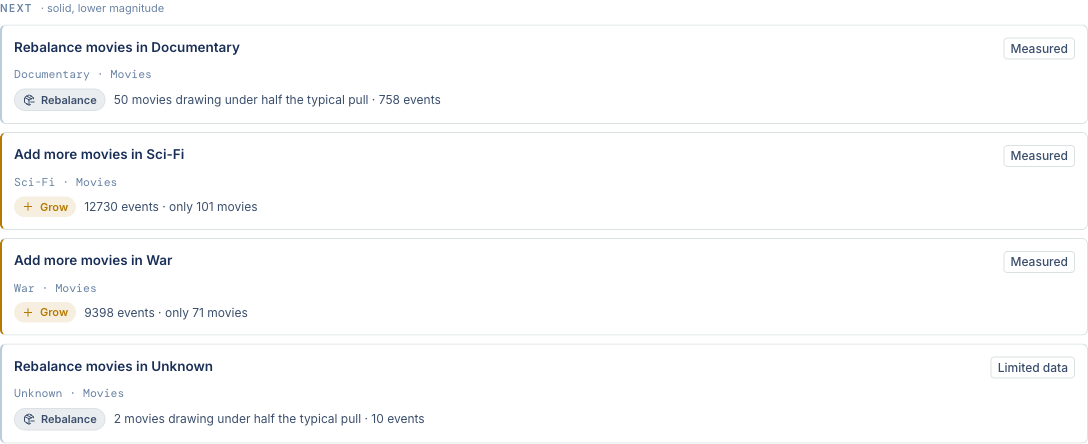
A few rows from the MovieLens worklist: the band header ("Next"), a verb-first headline, the reason, a detector chip (Rebalance, Grow), and a trust label on the right.
Anatomy of an opportunity
Each row is a specific, actionable bet:
- A verb-first headline — "Commission more sleep content," "Rebalance nutrition." The verb is chosen to match your business, so a publisher sees "Commission," a streamer "License," a retailer "Stock."
- The reason — the plain fact behind it: "2.4× the typical pull on only 12 articles."
- A band — how urgent the bet is (below).
- A trust label — how much evidence stands behind it. See Trust labels.
- Evidence — a small visual that shows the imbalance the opportunity is built on (a demand-vs-supply bar, a drop-off funnel, a recency meter, a week-over-week trend).
Click any row to open its detail, which spells out the numbers and the reasoning:
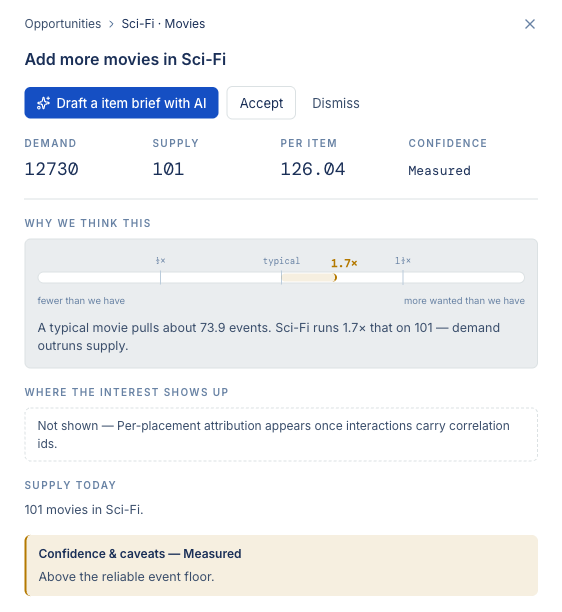
The detail for a "Grow" opportunity: demand and supply side by side, the per-item pull, the confidence tier, and a "Why we think this" bar placing the category against a typical one.
The three bands
Opportunities are grouped into three bands by urgency:
- Now — act this cycle. A clear, well-evidenced imbalance worth moving on.
- Next — worth planning, not yet urgent. Over-supply nudges and softer signals land here.
- Watch — keep an eye on it. Bets that are inferred rather than measured are held here so they never crowd out proven work.
Within a band, the default order is by how much demand is in play, so the biggest opportunities float to the top.
The kinds of opportunity
Each row is one of a handful of named readings of the supply/demand imbalance. You do not have to memorize these — the headline says what to do — but knowing the categories helps you scan:
- Expand — demand is outrunning a thin shelf. Make more.
- Rebalance — too much catalog for the demand it draws. Reallocate the effort.
- Establish — a category you promise but carry nothing in. Start covering it.
- Refresh — content in a fast-moving area has gone stale. Update it.
- Deepen — people drop out partway through a journey, like a course or a series. Fix the experience, not the catalog size.
- Ride — something is accelerating. Get ahead of it.
The set adjusts to your data
You will not always see every kind. An opportunity only appears when your data can actually support it. If your catalog has no dates, you will not see Refresh; if nothing tracks progress through a journey, you will not see Deepen. Nothing is faked and nothing is silently dropped — the tab shows the honest subset it can compute from what is connected, and grows as more of your data comes in.