Trust labels
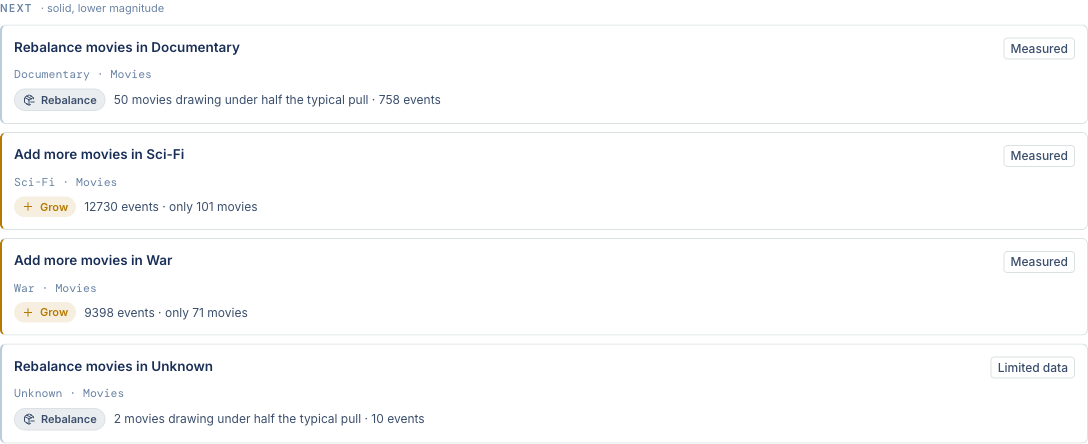
The label sits on the right of every row. Here one opportunity is Measured and another, resting on only 10 events, is Limited data.
Every opportunity carries a label saying how much evidence stands behind it. This is not decoration. You defend the roadmap to a boss and spend real money on it, so acting on a fabricated signal costs a wasted cycle of production. The label is what makes the worklist defensible, which is what makes it usable.
The four levels
- Measured — backed by real, verified user behavior. The interaction is genuine and the connections behind it are confirmed. Trust this like a fact.
- Limited data — the signal is real but thin: below the volume where the number is exact. Directional, not precise. Good enough to notice, not to bet the quarter on alone.
- Inferred — reasoned from something other than measured behavior, such as a category you declared but carry nothing in. A sensible bet, not a proven gap.
- Modeled — built partly on a synthesized or stand-in signal rather than observed behavior. Treat as a hypothesis.
The rule that protects you
A guess can never outrank a measured fact into the "act now" band.
Inferred and modeled opportunities are held in the lower bands no matter how large they look. That means the top of your worklist is always the work you can most trust, and a big-but-unproven idea cannot push a smaller, certain win off the top.
Why an opportunity is "only" Inferred or Modeled
Usually it means the underlying data is not yet fully connected. You cannot prove a real interaction without a genuine behavior stream, and you cannot measure a hole in a category from data that was never there. As you connect more of your data — behavior, inventory, outcomes — opportunities that were Inferred or Modeled can graduate to Measured on their own. The worklist gets more confident as the platform sees more, without you changing anything.